
Chain Swivels for Fishing: Anti-Tangle Design & Size Guide
Table of Contents
- What Is a Chain Swivel and How Does Its Design Help Reduce Tangles?
- Chain Swivel vs. Barrel Swivel vs. Ball Bearing: Key Differences
- Chain Swivel Size and Load Capacity Chart
- Best Fishing Scenarios for Chain Swivels
- How to Rig a Chain Swivel to Help Reduce Tangles
- Frequently Asked Questions
- Conclusion
If line twist and tangled rigs are costing you fish, chain swivels fishing setups can help reduce these problems. Chain swivels use multiple linked ball-and-socket joints that rotate independently, giving your line and leader more freedom of movement than a single-joint swivel. This guide explains how chain swivels work, how they compare with other fishing swivels, and how to choose and rig the right size.

👆🏻 Click to explore this fishing tackle
What Is a Chain Swivel and How Does Its Design Help Reduce Tangles?
A chain swivel is a multi-joint connector made up of three or more interlocking ball-and-socket links that rotate independently. Unlike a standard barrel swivel with one rotating joint, it distributes rotational force across multiple pivot points, helping limit twist transfer back to the main line.
When a lure, bait, or spinner rotates during a retrieve, it generates torque. A chain swivel spreads that rotational load across several pivot points, helping the system continue rotating smoothly under tension.
Most chain swivels are made from stainless steel or high-grade brass with round wire end rings. These rings reduce the chance of sharp edges damaging monofilament or fluorocarbon, while polished ball links can help the joints rotate with less friction. Some models also use nickel-plated or black-oxide finishes to reduce visible flash.
Chain swivels are typically available in four-ball and six-ball configurations. Four-ball models are more compact for lighter presentations, while six-ball models provide more rotational capacity for higher-twist applications such as deep trolling or rigs with multiple spinner blades.
Chain Swivel vs. Barrel Swivel vs. Ball Bearing: Key Differences

Barrel Swivels for Fishing
Barrel swivels for fishing are a common choice in freshwater and inshore saltwater fishing. They are compact and affordable, but the single rotating joint can bind under tension. For simple rigs with limited rotation, they may be sufficient; spinning lures, fast retrieves, and rolling live bait place greater demands on swivel rotation.
For a basic Carolina rig, bottom dropper rig, or other setup with limited rotation, a barrel swivel can work well. More rotationally demanding presentations may call for a swivel with greater rotational freedom.
Ball Bearing Swivels
Ball bearing swivels use precision ball bearings inside the body to allow the eye loops to rotate with low friction under load. They are often used for high-speed trolling and heavy offshore applications where a lure or bait creates constant rotational load. The trade-off is higher cost, and they may be unnecessary for light freshwater rigs.
Where Chain Swivels Fit In
Chain swivels sit between barrel and ball bearing swivels in design and typical use. Their multiple joints provide more articulation than a barrel swivel and can be useful where continuous rotation or leader movement is a concern, including pike stinger rigs, in-line spinners, and live bait presentations.
Chain Swivel Size and Load Capacity Chart
👆🏻 Click to explore this fishing tackle
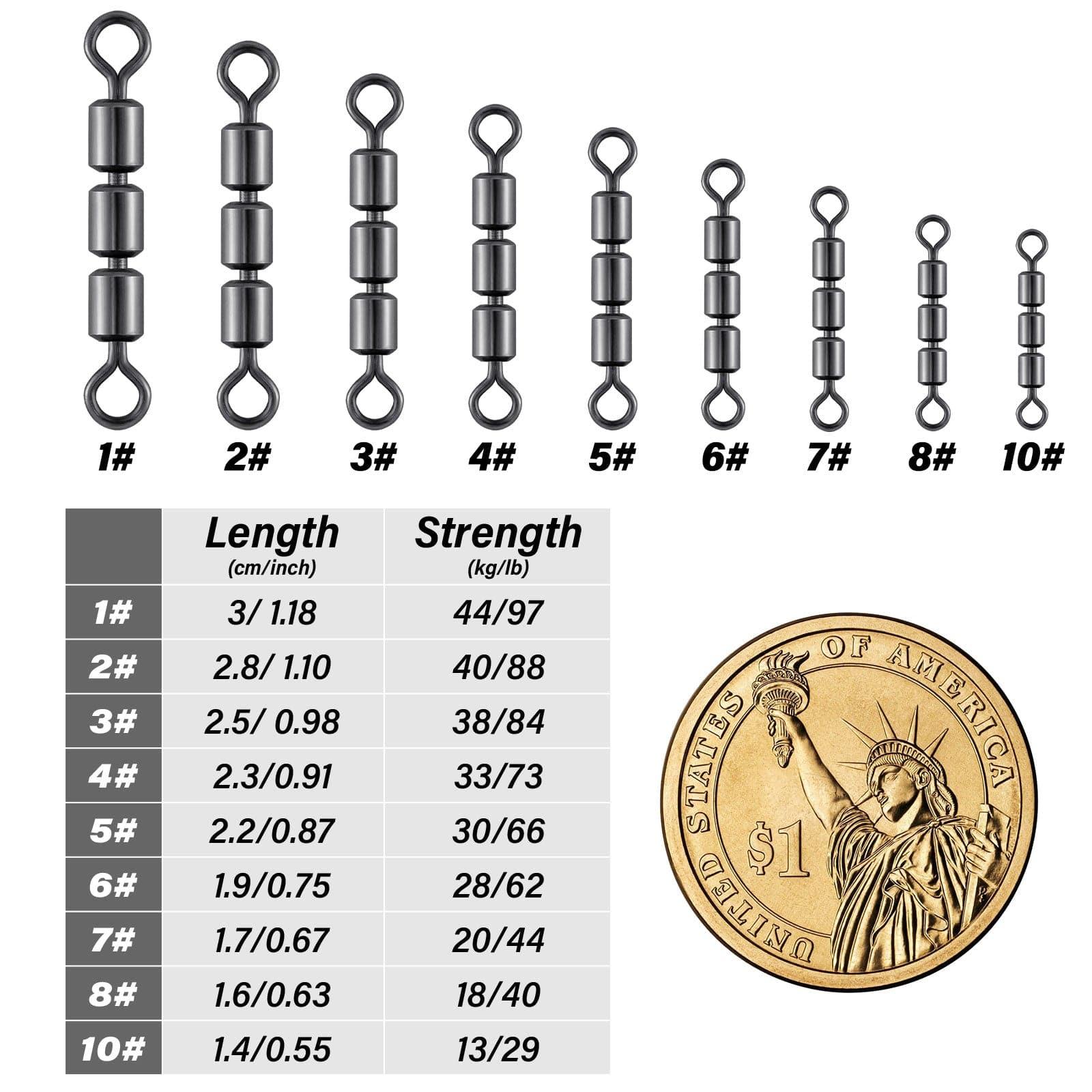
Choose a chain swivel based on rated strength and physical size. A swivel that is too small may not provide enough strength, while one that is too large can add unnecessary bulk. Use the chart below as a general reference, and always compare the manufacturer's rating with your line, leader, and target application.
General Size and Strength Reference
| Size Range | Strength Range | Typical Target Species | Typical Fishing Applications |
|---|---|---|---|
| 10#–8# | 29–40 lb | Trout, panfish, bass, walleye | Light freshwater fishing and spinning rigs |
| 7#–6# | 44–62 lb | Bass, walleye, pike, catfish | General freshwater fishing and light trolling |
| 5#–4# | 66–73 lb | Pike, muskie, striped bass, redfish, snook | Heavy freshwater and light inshore saltwater fishing |
| 3#–1# | 84–97 lb | Large pike, muskie, catfish, striped bass | Heavy freshwater, inshore, nearshore and trolling |
Match the swivel's rated breaking strength to at least the breaking strength of your main line, and consider the leader rating when it is higher. For many freshwater setups, sizing up one step can provide a useful margin without adding excessive bulk.
When selecting weighted fishing swivels, also account for the added weight and its effect on rig depth and presentation. They can be useful in float and bombarda-style rigs where the swivel helps control depth while limiting line twist.
Best Fishing Scenarios for Chain Swivels

Trolling with Spinning Lures
Trolling places heavy rotational demands on a swivel because spoons, in-line spinners, and some crankbaits can rotate continuously. Chain swivels can help manage that rotation in setups such as walleye spinner rigs, salmon trolling with spoons, and lake trout fishing with deep-diving lures.
Pike and Muskie Stinger Rigs
Pike and muskie stinger rigs often use wire or heavy fluorocarbon leaders, and large baits may spin or roll during the retrieve. A chain swivel between the main leader and stinger section can allow the trailing hook to move more freely while helping limit twist transfer through the rig.
Bombarda and Float Fishing Rigs
Bombarda fishing uses a weighted float to cast lightweight lures long distances. A chain swivel between the float and leader can help manage rotation from both the float and spinning lure.
Live Bait Fishing for Catfish and Striped Bass
Large live bait such as shad, herring, and bluegill can create twist when they swim in circles. A chain swivel between the main line and leader allows the bait to move more freely while limiting rotational force transferred up the line.
Explore our fishing swivels and snaps at Dr.Fish for swivel styles and sizes used in freshwater and saltwater fishing.
How to Rig a Chain Swivel to Help Reduce Tangles

Choosing the Right Knot for Chain Swivel End Rings
The end rings on a quality chain swivel are round wire loops compatible with standard fishing knots. For monofilament and fluorocarbon, the improved clinch and Palomar knots are common options; for braid, the Palomar or double uni knot can be used. Wet the knot before cinching to help reduce friction.
Positioning the Chain Swivel in Your Rig
For most applications, place the chain swivel between the main line and leader rather than directly at the lure or hook. Keeping it farther from the lure can reduce interference with lure action. A leader of 18 to 36 inches is a practical starting point for many freshwater setups, while shorter leaders may be used in some saltwater applications.
Checking and Maintaining Your Chain Swivel
Before each fishing session, check chain swivels for corrosion, bent links, or stiff joints. Rinse saltwater swivels with fresh water after use, let them dry completely, and replace any swivel with visible rust, deformation, or restricted rotation.
Frequently Asked Questions
What is the main advantage of a chain swivel over a standard barrel swivel?
The main advantage is the multi-joint design. A barrel swivel uses one rotating joint, while a chain swivel uses three or more linked joints that rotate independently. This can help manage line twist in higher-rotation applications such as trolling, live bait fishing, and stinger rigs.
Can I use a chain swivel with braided fishing line?
Yes. Chain swivels can be used with braided fishing line when the connection is tied correctly. Palomar and double uni knots are common choices for the swivel end ring. Wet the knot before tightening and seat it slowly.
How do I know what size chain swivel to use for my fishing setup?
Start with the swivel’s breaking strength. Choose one rated at least as strong as your main line and leader. For example, with 20 lb line and leader, use a chain swivel rated for at least 20 lb. Then choose the smallest size that provides enough strength without adding unnecessary bulk.
Are chain swivels suitable for saltwater fishing?
Yes, provided the swivel is made from stainless steel or another corrosion-resistant material suited to saltwater. Rinse it with fresh water after each session and let it dry before storage. For very heavy offshore applications, anglers may choose ball bearing swivels when high rotational performance under load is required.
Do chain swivels affect lure action or spook fish?
A relatively large swivel can affect a small or finesse lure when placed too close to it. Positioning the swivel between the main line and leader keeps its weight and profile farther from the lure. In clear water, a lower-visibility finish can also reduce the connector's visual presence.
Conclusion
Chain swivels fishing applications range from ultralight trout rigs to trolling and live-bait setups. Choosing the appropriate swivel type and size, then positioning it correctly, can help manage line twist without adding unnecessary bulk.
Whether you are dealing with a spinning lure, active live bait, or a trolling rig, a properly selected chain swivel can be a useful tool for managing twist. Explore Dr.Fish's swivel and terminal tackle selection for freshwater and saltwater fishing.

0 comments